Tuesday, September 22, 2026
SUBSCRIBE
22 GLOBAL MEDIA AWARDS
Food For Mzansi
  • News
  • Changemakers
  • Lifestyle
  • Farmer’s Inside Track
  • Food for Thought
No Result
View All Result
  • News
  • Changemakers
  • Lifestyle
  • Farmer’s Inside Track
  • Food for Thought
No Result
View All Result
Food For Mzansi
No Result
View All Result
in News

‘Farmers carry burden of apartheid-era dispossessions’

by Jan-Jan Joubert
25th February 2021
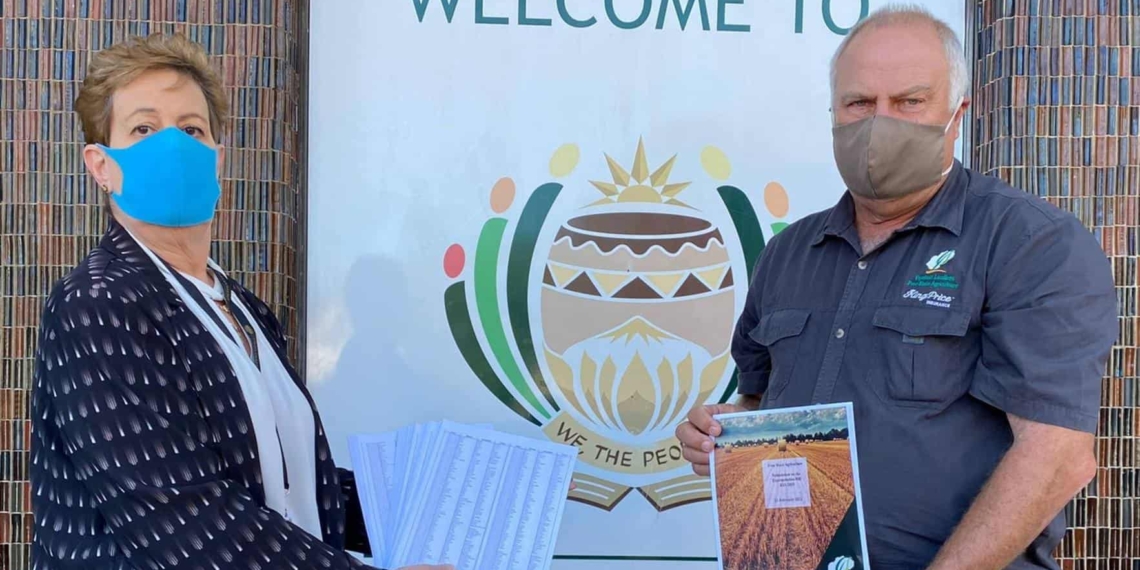
Free State Agriculture president Francois Wilken featured with DA MP Madeleine Hicklin on the steps of Parliament in Cape Town. Photo: Supplied/Food For Mzansi

Free State Agriculture president Francois Wilken featured with DA MP Madeleine Hicklin on the steps of Parliament in Cape Town. Photo: Supplied/Food For Mzansi

Share on FacebookShare on TwitterShare on WhatsApp

Free State Agriculture (FSA) president Francois Wilken has handed in 80 000 signatures against the Expropriation Bill, which will now be tabled in Parliament by the Democratic Alliance (DA).

The signatures and a document setting out Free State Agriculture’s opposition to  the bill, were handed to DA MP Madeleine Hicklin. She serves on the parliamentary portfolio committee on public works, which is processing the bill.

Free State Agriculture president Francois Wilken outside Parliament with some of the 80 000 signatures the agricultural powerhouse handed in against the Expropriation Bill. Photo: Supplied/Food For Mzansi

Hicklin will now table it in the committee.

FSA represents a membership of about 3 400 commercial farmers in the Free State.

Its submission joins a growing mass of documents to be taken into account when the bill is finally considered.

Both the DA and the Freedom Front Plus have urged South Africans to add their opposition to the bill before the window for public submissions on its content closes on Sunday.

FSA’s main objections to the bill centre on clause 1. This deals with the strengthening of municipal powers and defines expropriation in the public interest – too widely, in the agricultural group’s opinion.

They also take issue with clause 3, which (by FSA’s interpretation) hands the state de facto control over all property.

ALSO READ: A trail of crumbs on agriculture’s future

Flowing from these interpretations, FSA lists four primary concerns to the Expropriation Bill.

This is the bill’s impact on land reform, the implications for compensation, the focus on property in general rather than agricultural property in particular, and the impact of expropriation on South Africa as a whole.

Agri SA’s points of concern

Meanwhile Agri SA has also submitted its views on the bill. It is a wide-ranging and empirically researched document making the following main points:

SONA: Christo van der Rheede, the deputy executive director of Agri SA.
Christo van der Rheede, executive director of Agri SA. Photo: Supplied/Food For Mzansi
  • Agri SA represents the largest group of rural landowners and wishes to ensure a sustainable, viable sector. 
  • The farmers of today cannot alone be held liable for historic events and cannot be expected to carry the burden of apartheid-era dispossessions. 
  • Agri SA remains firm in its support for free market principles. 
  • Landowners whose land is expropriated should always have the right to approach the courts. 
  • Reference is made to the study on the potential economic impact of zero compensation or minimal compensation, specifically the impact on capital formation, as well as the study on the impact of the pandemic on the agricultural sector. 
  • An international perspective is provided, namely that the constitutions of most countries require that compensation be paid. Reference is made to the United Nations Food and Agriculture Organisation’s study on best practice for compulsory acquisition of property. 
  • The lessons learnt from Zimbabwe and Venezuela are shared to illustrate the disastrous effect that their land policies had on the respective economies. 
  • The implications in terms of potential loss of tax income for the government, as well as the potential negative impact on food security, are also highlighted. 
  • Commentary is provided on specific definitions and clauses, such as the definition of ‘expropriation’ and ‘public interest’ and the zero-compensation clauses. 
  • Agri SA believes strongly that landowners should immediately receive adequate and effective compensation, which will enable them to start again elsewhere, and that they should not be worse off as a result of expropriation.  

ALSO READ: ‘Free new farmers from being state tenants’

Jan-Jan Joubert

Five farming friends, one vision: Growing from setbacks to success
It Takes a Village

Five farming friends, one vision: Growing from setbacks to success

by Vateka Halile
18th September 2026

Isondlo Holdings in KwaMhlanga, Mpumalanga, is proof that unity builds legacy. Overcoming early setbacks and high poultry mortality, the partners...

Read moreDetails

Under siege: Women in farming demand action amid rising violence

18th September 2026
Agoa extension offers relief, but SA agri needs long-term certainty

Agoa extension offers relief, but SA agri needs long-term certainty

18th September 2026
TrailTail: WC dog lover makes natural treats with local meats

TrailTail: WC dog lover makes natural treats with local meats

17th September 2026
Know your water and soil: Practical tips for smarter drip irrigation

Know your water and soil: Practical tips for smarter drip irrigation

17th September 2026

Agoa extension offers relief, but SA agri needs long-term certainty

Five farming friends, one vision: Growing from setbacks to success

Know your water and soil: Practical tips for smarter drip irrigation

Is your hemp crop too thirsty? New drone data reveals the truth

Maize surplus eases feed costs, but fuel and drought threaten gains

Join Food For Mzansi's WhatsApp channel for the latest updates!

JOIN NOW!
Next Post
Journalist, author and well-known political commentator Jan-Jan Joubert. Photo: Supplied/Neels Jackson

Agriculture 'shining light in Tito's gloomy budget'

THE NEW FACE OF SOUTH AFRICAN AGRICULTURE

With 21 global awards in the first six years of its existence, Food For Mzansi is much more than an agriculture publication. It is a movement, unashamedly saluting the unsung heroes of South African agriculture. We believe in the power of agriculture to promote nation building and social cohesion by telling stories that are often overlooked by broader society.

Khula! wins eight Pixels at the 2026 IAB Bookmark Awards

Farming bootcamp propels Unicha Dladla’s path to growth

Grazing shortages? Here is how Voermol protects livestock wealth

Maize surplus eases feed costs, but fuel and drought threaten gains

This week’s agri events: 21-25 September

Is your hemp crop too thirsty? New drone data reveals the truth

  • Awards & Global Impact
  • Our Story
  • Contact Us
  • Cookie Policy
  • Privacy Policy
  • Copyright

Contact us
Office: +27 21 879 1824
News: info@foodformzansi.co.za
Advertising: sales@foodformzansi.co.za

Contact us
Office: +27 21 879 1824
News: info@foodformzansi.co.za
Advertising: sales@foodformzansi.co.za

  • Awards & Global Impact
  • Our Story
  • Contact Us
  • Cookie Policy
  • Privacy Policy
  • Copyright

Chat Options

I'm Lerato, your AI assistant!
No Result
View All Result
  • News
  • Changemakers
  • Lifestyle
  • Farmer’s Inside Track
  • Food for Thought

Copyright © 2024 Food for Mzansi

This website uses cookies. By continuing to use this website you are giving consent to cookies being used. Visit our Privacy and Cookie Policy.